Is the Rice Purity Test Accurate? What Psychologists Actually Say
📋 Table of Contents
You scored a 63. Your roommate got an 88. Now you're both squinting at your phones wondering what that gap means — and whether the number actually says something true about who you are. That's the real question hiding underneath every screenshot in the group chat: is the Rice Purity Test accurate?
Short version: not in the way most people assume. The Rice Purity Test can tell you something honest about yourself, but it measures nothing close to "purity," and comparing your score to anyone else's is where the whole thing quietly falls apart. Below, we'll unpack what psychology actually says about self-scored quizzes like this one — including one flaw almost no other article mentions.
Quick Snapshot
- What it is: A 100-item, self-graded checklist of life experiences. More boxes ticked = lower score.
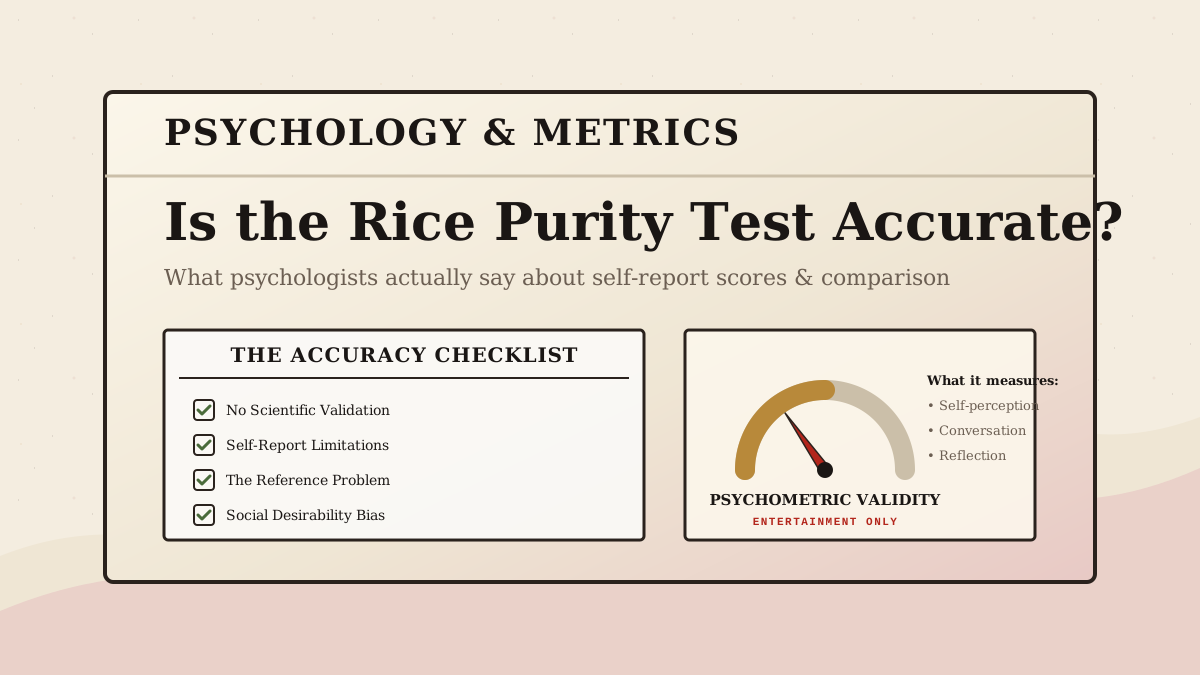
- Is it accurate? Not as a measurement instrument. It has no scientific validation, no standardized scoring, and no agreed-upon definition of what "purity" even is.
- What it's actually good at: Reflecting your self-perception in a moment, and starting conversations.
- Who it's for: Mostly 17+, with the biggest audience being college-age (18–22).
- The catch: Two honest people can answer the exact same question completely differently — which makes cross-person comparison unreliable.
- Fun fact: Nobody fully agrees when it started. Sources place its origin anywhere from a 1924 student-newspaper survey to the early 1980s.
⚡ Fast Facts: Rice Purity Accuracy Dashboard
100-item checklist of life behaviors. Lower score indicates more experiences.
Extremely low. Zero psychometric validation, standard norms, or clinical oversight.
Captures momentary self-perception, breaks the ice, and prompts personal reflection.
Unreliable due to the Reference Problem (different definitions for same questions).
First, What Would "Accurate" Even Mean Here?
When psychologists ask whether a test is accurate, they're really asking two questions: does it measure what it claims to measure (validity), and does it give consistent results (reliability)? Real psychological instruments — like the MMPI-2 — are built with validation studies, normative data, and even built-in scales to catch people who fudge their answers.
The Rice Purity Test has none of that. It was never designed as a scientific measure and no organization oversees it — even the sites that host it openly say it's for entertainment, not assessment. So the honest answer to "is the Rice Purity Test accurate" starts with a reframe: accurate at what? Because the label on the tin — "purity" — is the first thing that doesn't hold up.
The Psychology: 5 Reasons It Isn't "Accurate"
1. "Purity" isn't a real, measurable thing
Psychologists call this a construct-validity problem. Anxiety, extraversion, working memory — these are defined constructs researchers can measure. "Purity" is not. It's a value-loaded word standing in for a simple tally of experiences. Naming a number "purity" doesn't make the number mean purity — it just borrows a moral vibe the score can't actually support. A 40 doesn't make you less good, less mature, or less anything. It's a count, dressed up as a verdict.
🔍 Construct Validity: "Purity" vs. Scientific Metrics
Psychology measures scientifically validated constructs, whereas "purity" is a subjective social construct:
The "Purity" Score
- Counts actions with no context
- Assumes a moral baseline (100 = "good")
- Lacks scientific definitions
- Bends based on cultural expectations
Psychological Constructs
- Measures defined states (e.g., Anxiety)
- Neutral, non-judgmental scoring
- Validated through empirical peer reviews
- Normalized across broad demographics
2. It relies entirely on self-report
Internal states and personal history aren't directly observable — only you can answer, which means the result is only as reliable as your memory and honesty in that moment. Your mood, how tired you are, whether you're taking it alone or with laughing friends — all of it nudges the number. That's not a flaw unique to this quiz; it's the built-in limitation of every self-report survey. But serious instruments add safeguards to compensate. This one doesn't.
3. The "reference problem" — the flaw nobody talks about
Here's the big one. Even when two people answer honestly, they may be answering different questions in their heads. Take an item like "have you ever been in a relationship." One person counts a two-week situationship; another only counts something serious and official. Same checkbox, two completely different internal definitions.
Psychologists call this variability in reference points, and it's exactly why comparing scores across people is shaky. Your 63 and your roommate's 88 aren't measured on the same ruler — you're each quietly using your own. So the group-chat leaderboard? It's comparing apples to slightly different apples.
📏 Visualizing the Reference Problem
How two people answering the exact same question honestly produce mismatched scores:
Despite identical actions, Person A receives a lower score than Person B simply due to differing internal definitions.
4. Social desirability bias bends the answers
People shade their responses depending on who's watching. Taking it privately, you might tick boxes honestly. Passing your phone around a dorm, you might round up to look bolder — or round down to look tamer. Neither version is "the real you." Both are performances shaped by the room, and the score can't tell the difference.
📊 Self-Report Bias Factors: What Skews Your Score?
Social Desirability
Modifying answers to fit in with peers or avoid embarrassment in group settings.
Reference Discrepancy
Different standards for vague questions (e.g., "held hands romantically").
Mood & Context
Fatigue, current stress, or group pressure shifting how checklists are answered.
Memory Recall
Unintentional errors in recalling specific behaviors from years in the past.
5. There's no validation, no norms, no oversight
A genuinely accurate test is peer-reviewed and standardized so that a given score means the same thing for everyone. The Rice Purity Test has none of this machinery. There's no official version, no scoring authority, and the "average scores" floating around online come from self-selected internet samples, not representative research. Treat any "average by age" chart as entertainment, not data.
⚖️ Side-by-Side: Rice Purity vs. Validated Psychometrics
| Feature | Rice Purity Test | Standardized Instrument (e.g., MMPI-2) |
|---|---|---|
| Primary Purpose | Social icebreaker / Entertainment | Clinical diagnosis / Research |
| Validity Scales | ❌ None (assumes 100% honesty) | ✔️ Built-in (catches lying & exaggeration) |
| Standardized Norms | ❌ None (unregulated online pools) | ✔️ Demographically balanced samples |
| Peer-Reviewed | ❌ No scientific scrutiny | ✔️ Subject to decades of journal reviews |
| Definitions | Vague (open to user interpretation) | Strictly controlled operational questions |
So What Is the Rice Purity Test Accurate At?
This is where the honest answer gets more interesting than a flat "it's fake." The test genuinely is accurate at a few things — just not the ones printed on the label:
- A snapshot of your self-perception. It captures how you see your own experiences today. Retake it in two years and the number moves — that shift is arguably the most meaningful thing it reveals.
- A conversation catalyst. Its original campus purpose was breaking the ice, and it's reliably good at that. Comparing answers surfaces stories and values you'd never reach with small talk.
- A gentle self-reflection prompt. Used privately, it can nudge you to think about your own choices and boundaries — no comparison required.
Notice what these have in common: none of them require your number to match anyone else's. The test works best the moment you stop treating it as a scoreboard.
A Quick Note on Its Murky Origins
Part of why people assume the test is official is its Rice University pedigree — but even that history is fuzzier than most articles admit. Some accounts trace it to a 1924 survey published in Rice's student newspaper; others point to the 1960s; and the familiar 100-question format seems to have taken shape closer to the 1980s before going viral online. The disagreement itself is a useful reminder: a quiz whose own start date can't be pinned down was never built to deliver precise measurements of your character. Check out our in-depth Complete History of the Rice Purity Test for a full milestone-by-milestone breakdown, or read about the Rice University Purity Test Origin to see how residential dorms shaped the quiz.
How to Actually Read Your Score (Healthily)
- Read it as a mirror, not a grade. It reflects your experiences, not your worth.
- Skip the comparison spiral. Because of the reference problem, ranking yourself against friends is comparing mismatched rulers.
- Notice your reaction. Feeling proud, embarrassed, or anxious about a number says more about your current headspace than the number does.
- Keep it private if you want to. You're never obligated to share a result — and the test explicitly warns it's not a bucket list to complete.
If a quiz result ever leaves you genuinely distressed or fixating on how you "measure up," that's a sign to step back and talk to someone you trust — the score isn't worth that weight.
🔄 The Healthy Mindset Funnel: Processing Your Score
Mirror, Not Grade
Understand that the number reflects experiences, not your character or morality.
Skip Comparison
Recognize the reference problem and avoid comparing scores with friends.
Check Reactions
Observe how the score makes you feel to learn about your current boundaries.
Keep It Private
Share it only if you want to. You have no social obligation to disclose results.
Frequently Asked Questions
Is the Rice Purity Test accurate?
Not as a real measurement. It has no scientific validation, no standardized scoring, and no clear definition of "purity." It accurately reflects your self-perception and makes a great conversation starter — but it can't objectively rate your character, morality, or maturity.
Is the Rice Purity Test scientific?
No. It isn't peer-reviewed, normed, or overseen by any authority, and even the sites hosting it describe it as entertainment. It shares surface features with real surveys but lacks the validity and reliability checks that make a test scientific.
Why can't I compare my score to my friends'?
Because people interpret the questions differently — psychologists call this the reference problem. Two honest people can read the same item in totally different ways, so your scores aren't measured on the same scale, making direct comparison unreliable.
What's a "good" or "bad" Rice Purity Test score?
There isn't one. A higher score just means fewer listed experiences and a lower score means more — neither is better or worse. The number reflects your path, not your value, so "good" and "bad" don't really apply. Explore our Good Score Guide or our Score Meaning breakdown for details on score interpretations.
Does my score define my personality or morality?
No. It's a tally of specific experiences, not a personality assessment or moral judgment. Real character shows up in how you treat people and the choices you make — none of which a 100-item checkbox quiz can capture.
Can my results be trusted if I answered honestly?
Even with total honesty, your answers depend on memory, mood, and how you personally define each question — so the result is a rough, momentary snapshot rather than a precise reading. It's meaningful as self-reflection, not as objective fact.
Is it safe and private to take?
It can be, but it depends on the site. Choose one that doesn't ask for personal information and doesn't store your answers. Taking it privately also removes the social pressure that can skew how you respond. Read more about taking the test anonymously and check out how to safely share your score.
The Bottom Line
So, is the Rice Purity Test accurate? As a science-grade measure of your innocence — no, and it never claimed to be. What it can do is hold up an honest mirror to how you see your own experiences in this moment, and give you and your friends something real to talk about. The trap is treating a playful checklist like a verdict on your worth. It isn't one. Your score is a snapshot, not a sentence — closer to a Spotify Wrapped than a report card.
Curious where you land today — and how it might shift a year from now? Take the Rice Purity Test here and read your result as a starting point for reflection, not a scoreboard.
Sources & further reading: The Rice Thresher (1924 archives); Wikipedia, "Purity test" (folklore genre and 1930s campus history); The Independent (Gen Z TikTok coverage); The Trail, "The Impure Truth About the Rice Purity Test" (historical critique and honors-thesis context); Her Campus (Gen Z quiz psychology).
📖 Read Our Latest Published Blogs
Explore more in-depth history and score interpretations from our team:
How It Went Viral
The 100-year evolution of the test from campus print to global TikTok meme.
OriginsWhat Is Rice University?
The origin story detailing why residential dorm colleges created this icebreaker.
TimelineComplete History of the Test
A full milestone-by-milestone breakdown from 1924 print to TikTok video duets.
Score 60What a Score of 60 Means
Analyze why a score of 60 hits the exact student average with balanced experience.