MBTI, Love Language & Attachment Style: What Your Quiz Results Really Say About You
📋 Table of Contents
You're an ENFP, your love language is Words of Affirmation, and you're "anxiously attached." Congratulations — according to the internet, you now have a complete personality. But here's the awkward question nobody in the group chat asks: do these three results actually agree with each other, and which one is telling you the truth?
That's the thing about what your quiz results say about you — we stack them like a personality starter pack, screenshot the aesthetic ones, and quietly ignore the rest. This guide breaks down what MBTI, love languages, and attachment styles each actually measure, which ones hold up to real science, and how to read your results without turning a fun 10-minute quiz into a personality prison.
Quick Snapshot
- What it is: Three of the internet's most-shared self-quizzes — MBTI (personality type), the Five Love Languages (how you express affection), and attachment style (how you bond in relationships).
- Who it's for: Anyone who's ever screenshotted a result and captioned it "this is SO me."
- How they differ: One measures preferences, one measures behaviour in love, and one measures emotional patterns from early life — they're not interchangeable.
- Why it matters: Knowing which quiz measures what stops you from mistaking a fun label for a fixed identity.
- Fun fact: MBTI was developed by a mother-daughter team with no formal psychology training — yet it's now taken by an estimated 2 million people a year.
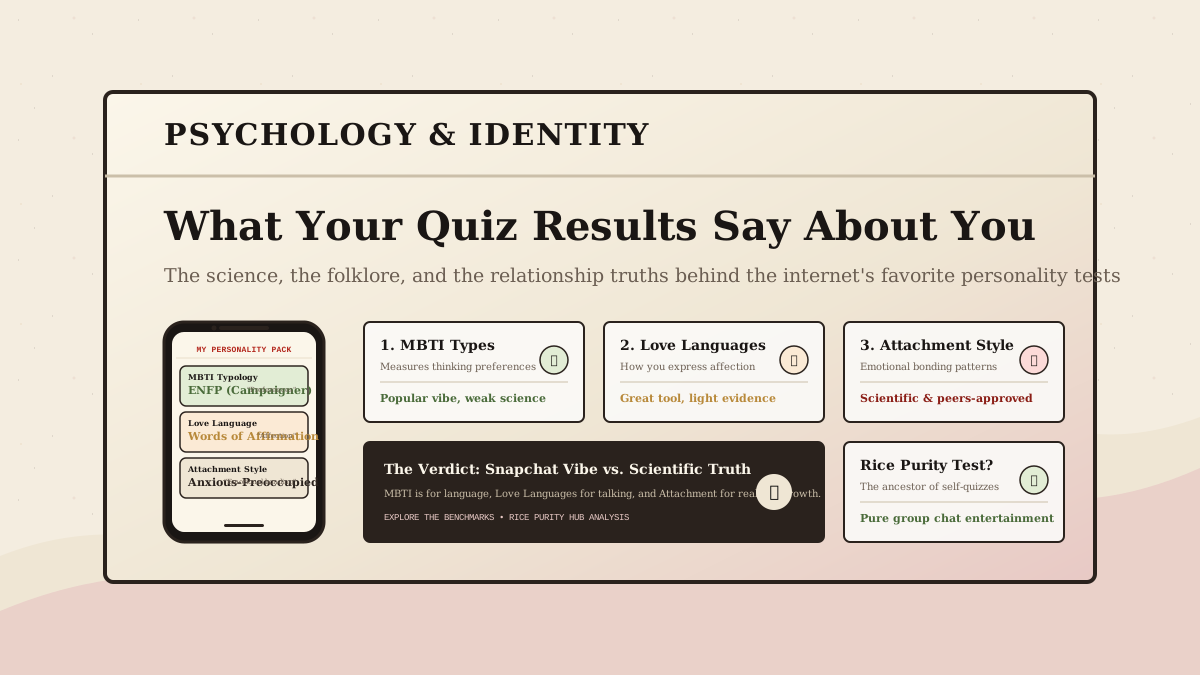
⚡ Fast Facts: The Personality Quiz Landscape
Sorts you into 16 types based on cognitive preferences. Great for icebreakers and self-language.
Identifies how you express/receive affection. Ideal for dating conversations, less for strict science.
Measures emotional bonding patterns based on child development theory. Highly scientifically validated.
A 100-question subtractive checklist. Pure entertainment to capture life experiences with friends.
The One Thing These Quizzes Have in Common (and It's Not Science)
MBTI, love languages, and attachment style feel like they belong to the same family. They don't. They come from wildly different places, and lumping them together is exactly why so many people misread their own results.
What they do share is a hook: the moment of recognition. That little dopamine hit of "oh my god, that's literally me" is the real product. Understanding that is step one — because the value of a quiz isn't in the label it hands you, it's in the self-reflection it kicks off. Same reason people can't stop taking the Rice Purity Test — the number matters less than the conversation it starts.
MBTI: The Fun One That Science Side-Eyes
The Myers-Briggs Type Indicator (MBTI) sorts you into 16 types across four letters — introvert/extravert, sensing/intuition, thinking/feeling, judging/perceiving. It's the vibe-check of personality quizzes, and it's genuinely great for language: "I'm more of an I than an E" is a useful shorthand.
Here's the honest part most listicles skip. **MBTI explained** by actual psychologists comes with a big asterisk. Research consistently finds that MBTI has weak test-retest reliability — studies suggest a large share of people get a different type when they retake it just weeks later. It also forces you into either/or boxes when most human traits sit on a spectrum. Psychologists generally prefer the "Big Five" model for that reason.
So what does your MBTI actually say about you? It captures how you prefer to think and recharge in this season of your life. Treat it like a Spotify Wrapped — a snapshot of a mood, not a permanent tattoo.
📊 The 4 Core Dimensions of MBTI Spectrums
Note: Psychologists emphasize that people fall on a spectrum rather than hard binaries.
Love Languages: Wildly Popular, Lightly Evidenced
The Five Love Languages — Words of Affirmation, Quality Time, Acts of Service, Physical Touch, and Receiving Gifts — came from pastor and counsellor Gary Chapman in his 1992 book. The core idea is sticky and useful: people give and receive love differently, and mismatches cause friction.
But here's the information-gain bit competitors won't tell you. Recent research has been sceptical of the framework as science. Studies have found that people don't actually fall neatly into one dominant language, that love isn't a fixed "language" you're born speaking, and that the healthiest couples tend to use all five rather than rationing one. A 2022 review in a major psychology journal directly challenged the model's core assumptions.
What your love language really says about you: it's a fantastic conversation tool and a terrible rulebook. Use it to tell your partner "hey, I feel loved when you make time for me" — not to excuse never doing the dishes because "Acts of Service isn't my language."
❤️ The Five Love Languages Channels
Words of Affirmation
Verbal encouragement, compliments, and appreciation are key to emotional security.
Quality Time
Undivided attention, shared experiences, and engaging conversations without devices.
Acts of Service
Helpful actions, chores, and easing burdens that show care through active deeds.
Physical Touch
Non-verbal bonding, holding hands, hugs, and physical presence to feel connected.
Receiving Gifts
Visual symbols of love, thoughtfulness, and effort behind selecting a token.
Attachment Style: The One That Actually Holds Up
Plot twist — the quiz that sounds the most pop-psych is the one with the strongest scientific backbone. Attachment styles (secure, anxious, avoidant, and disorganised) grow out of attachment theory, pioneered by psychiatrist John Bowlby and researcher Mary Ainsworth in the mid-20th century. Decades of peer-reviewed research support it.
Your style describes how you learned to bond — usually shaped by early caregiving — and it genuinely predicts patterns in adult relationships. Anxiously attached people tend to fear abandonment; avoidant folks pull away when things get close; secure people do intimacy without the drama.
The empowering news: unlike a "type," attachment style can shift. Through self-awareness, secure relationships, or therapy, people move toward "earned secure attachment." So if your result stung a little — that's not a verdict, it's a starting point.
🛡️ Attachment Style Quadrants
Anxious-Preoccupied
Craves extreme intimacy, fears abandonment, highly sensitive to partner's emotional shifts.
Fearful-Avoidant
Desires connection but fears vulnerability. Experiences pull-push relationship dynamic.
Secure Attachment
Comfortable with intimacy, independent, communicates boundaries and emotions effectively.
Dismissive-Avoidant
Values extreme self-reliance, uncomfortable with intimacy, shuts down during conflict.
So Which Quiz Should You Actually Trust?
| Quiz | What It Measures | Science Rating | Best Used For |
|---|---|---|---|
| MBTI | Thinking & energy preferences | Weak reliability | Self-language, team icebreakers |
| Love Languages | How you express/receive affection | Popular, lightly evidenced | Relationship conversations |
| Attachment Style | Emotional bonding patterns | Strong research base | Real self-growth |
The takeaway: enjoy MBTI, use love languages as a talking point, and take attachment style seriously if you want the deepest insight.
⚖️ Framework Scientific Strength Scorecard
FAQs
What do quiz results actually say about you?
Most personality quiz results reflect your current self-perception and preferences — not a fixed, permanent identity. They're best used as mirrors for reflection and conversation starters, not as diagnoses or life sentences.
Is MBTI scientifically accurate?
Not very. MBTI has poor test-retest reliability and forces spectrum traits into rigid boxes. Psychologists generally favour the Big Five model. That said, MBTI is still fun and useful as everyday shorthand for how you operate.
Are the Five Love Languages real?
The concept is useful but not strong science. Research suggests people don't fit neatly into one language and that healthy couples use all five. Treat it as a communication tool, not a rulebook.
Can your attachment style change?
Yes. Attachment style is one of the more research-backed frameworks, and it's not fixed. Through self-awareness, secure relationships, and sometimes therapy, people can develop "earned secure attachment" over time.
Why do we love personality quizzes so much?
Quizzes offer identity, belonging, and that satisfying "that's so me" recognition. Social comparison theory suggests we take them partly to understand ourselves and partly to see how we stack up against everyone else.
Which personality quiz is the most accurate?
Of these three, attachment style has the strongest scientific support, followed loosely by love languages, with MBTI being the most fun but least reliable.
The Bottom Line
Here's what your quiz results really say about you: that you're curious enough to want to understand yourself — which is honestly the healthiest instinct on this whole list. MBTI gives you language, love languages give you a conversation, and attachment style gives you genuine insight. The trick is knowing which is which, and never letting a four-letter label do your growing for you.
So take the results, keep the ones that spark real reflection, and laugh off the rest. And if you're in the mood for one more quiz that's pure, low-stakes fun with your friends? Take the Rice Purity Test — just remember, same rule applies: it's a snapshot, not your story.
- Psychology Today – Attachment styles (psychological insight)
- American Psychological Association (APA) (personality research)
- Emily Impett et al. review on love languages, Current Directions in Psychological Science (2022) (information-gain source)
📖 Read Our Latest Published Blogs
Explore more in-depth history, comparison matrices, and psychology explainers from our team:
Viral Quizzes 2026
From the Rice Purity Test to MBTI and TikTok — discover what quizzes Gen Z can't stop taking.
ComparisonRice vs. Innocence vs. Purity Test
Are they the same quiz? Discover the key differences in formats, origins, and scoring logic.
PsychologyIs the Test Accurate?
Psychologists explain what self-report scores actually measure and why comparisons are misleading.
Viral HistoryHow It Went Viral
The 100-year evolution of the test from campus print to global TikTok meme.