Freshman Week Icebreakers That Aren't Awkward
📋 Table of Contents
Picture it: it's day two of orientation, a resident advisor claps their hands, and says the four words that make every stomach drop — "Let's go around the circle." Suddenly forty strangers are staring at their shoes, silently rehearsing "two truths and a lie" while praying they don't get picked first.
Here's the thing nobody tells you during freshman week: icebreakers aren't awkward by accident. There's a real psychological reason the good ones create instant friends and the bad ones make everyone want to fake a phone call — and once you understand it, you can pick (or run) icebreakers that actually work. This guide breaks down the best college icebreaker games for 2026, plus the science of why they land.
Quick Snapshot
- What it is: Low-pressure activities designed to help new students connect during freshman orientation and o-week.
- Who it's for: College students 18–25 starting their first year, plus RAs, o-week advisors, and club leaders running the sessions.
- Why it matters: The friendships you make in your first two weeks disproportionately shape your entire first year. First impressions stick.
- The secret: Great icebreakers minimize forced self-disclosure and maximize shared experience. Awkward ones do the opposite.
- Fun fact: Rice University's famously beloved O-Week sorts every new student into small groups of roughly 7–9 people who stick together all week — proving the best icebreaker isn't a game at all. More on that below.
⚡ Fast Facts: The 2026 Orientation Icebreaker Blueprint
Start with binary choices (this-or-that) to keep the cognitive load zero. No freezing up.
Use small groups (5-9 people) so every share gets a reaction. Large circles kill feedback.
Scavenger hunts and games make the activity the point, not the person. Instantly bonding.
Inspired by Rice O-Week: small, repeating groups turn o-week strangers into four-year friends.
Why Icebreakers Feel Awkward (The Part Everyone Skips)
Most listicles just throw 30 games at you and call it a day. But if you've ever cringed through one, you already know the game itself isn't the problem — the design is.
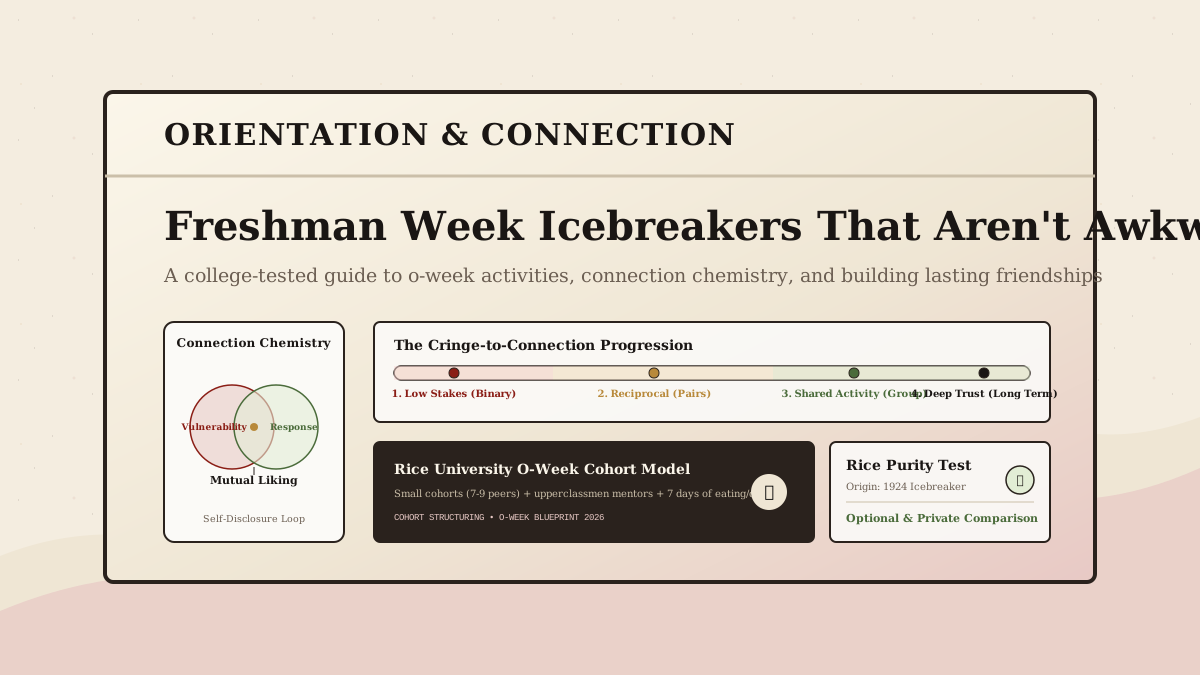
Social psychologists have a clean explanation. Connection is built through self-disclosure met with responsiveness: you share something, the other person genuinely reacts, and you both feel understood. Decades of research (summarized nicely in outlets like Psychology Today) show that when people share personal information and feel heard, they like each other more. That's the entire engine of friendship.
🧬 The Chemistry of Connection Loop
How self-disclosure and responsiveness combine to create real social bonding:
- Demand: Forced to reveal deep secrets immediately
- Response: Strangers stare blankly or plan their own lines
- Environment: Large circle (30-40 people)
- Result: Performance anxiety, self-consciousness & cringe
- Demand: Shallow, easy-to-answer preferences
- Response: Small group laughs, nods, or shares agreements
- Environment: Small cohort (5-9 peers)
- Result: Mutual validation, safety & organic friendships
The problem is that clumsy icebreakers demand the disclosure without guaranteeing the responsiveness. "Tell the group your deepest fear" forces vulnerability on a room of strangers who owe you nothing back. High cognitive load ("summarize your whole personality in one word") makes people freeze. And the dreaded go-around-the-circle format means everyone's too busy pre-writing their answer to actually listen to yours.
So the fix isn't "more fun games." It's three principles:
- Start shallow, then deepen. Binary choices ("window seat or aisle seat?") take seconds and require zero vulnerability. The brain processes them fast, so nobody freezes. Save the meaningful stuff for later in the week.
- Build in reciprocity. Pair people or use small groups so every share gets a reaction. Circles of 40 kill responsiveness; groups of 5 create it.
- Make the activity the point — not the person. Shared doing (a scavenger hunt, a group challenge) bonds people without spotlighting anyone. You end up with an inside joke instead of a performance.
📏 The Cringe-to-Connection Progression
Vulnerability level and engagement depth for each stage of orientation week:
By starting with low stakes and transitioning to shared tasks, group leaders guide new students from awkward self-consciousness to comfortable team bonding.
Keep those three in mind and almost any activity below turns from cringe to genuinely fun.
The Best Freshman Week Icebreakers (That Don't Suck)
Low-Stakes Warm-Ups (First 5 Minutes)
- This or That: Rapid-fire binary questions — pineapple on pizza, morning or night, beach or mountains. No pressure, instant energy.
- Stand Up If: "Stand up if you've never left your home state." "Stand up if you can quote an entire movie." People find their people fast, and nobody has to talk.
- Speed Introductions: 60 seconds per pair, then rotate. Short enough that it never gets uncomfortable, structured enough that everyone gets a reaction.
Shared-Experience Games (The Real MVPs)
- Campus Scavenger Hunt: Small teams race to find the weirdest statue, the best late-night food spot, the quietest study nook. You learn the campus and your group at once.
- Two Truths and a Lie — With a Twist: Instead of random facts, make them all about college hopes ("I'm secretly terrified of 8 a.m. lectures"). Suddenly everyone's bonding over the same anxiety.
- Human Bingo: A grid of squares like "has a tattoo," "is a first-gen student," "brought a plant to their dorm." Mingling with a mission beats mingling with dread.
Group Challenges (For Bigger O-Week Activities)
- Mini-Olympics: Rice's Brown College literally runs a floor-vs-floor mini-Olympics during o-week — relay races, silly contests, low skill, high laughter.
- Themed Nights: Trivia, karaoke, or a themed group challenge give introverts a reason to be in the room without being on the spot.
- The Purity Quiz Night (done right): Believe it or not, the Rice Purity Test started at Rice University as a lighthearted freshman-bonding survey — a self-graded checklist you compare with new friends. Because it's private, self-scored, and totally non-judgmental, it's a surprisingly great group icebreaker: everyone answers on their own phone, then shares only what they want. No forced confessions, just laughs. Just keep it optional, keep it light, and remember the score is a snapshot — not a verdict on anyone. (Curious what the numbers mean? See our score meaning guide.)
What Rice's O-Week Teaches Us About Orientation Week Ideas
Here's the genuinely useful insight: the college with arguably the most legendary freshman orientation in the U.S. barely relies on gimmick games at all.
At Rice University, O-Week (running August 16–22 in 2026) drops every new student into one of 11 residential colleges, then into a tiny group of 7–9 peers led by trained upperclassmen advisors. That group eats together, explores Houston together, and walks through the iconic Sallyport together — for a full week.
🏫 Rice University O-Week Structural Blueprint
11 Residential Colleges
Every student is sorted into a permanent, highly supportive physical college, building macro-identity.
7-9 Peer Cohort Groups
Tiny small-group structures within the college ensure instant faces and eliminate large-circle overwhelm.
Upperclassmen Mentors
Highly trained older student advisors guide each small cohort, offering direct institutional wisdom.
7 Days of Shared Experience
A full week of shared meals, lectures, city trips, and traditions builds safety through repetition.
Why does it work so well? It nails all three principles above without anyone realizing it. Small groups guarantee responsiveness. Shared experiences (not spotlights) do the bonding. And repetition — seeing the same faces for seven straight days — turns strangers into a friend group before classes even start. Many Rice students say those o-week groups stay close for all four years.
The takeaway for any campus: if you're an RA or o-week leader, prioritize small, repeated, low-pressure contact over one big flashy game. And if you're a nervous freshman? You don't need to be charming on day one. You just need to keep showing up to the same room.
Who This Is For (and a Gentle Caveat)
These ideas work for RAs, orientation leaders, club founders, and any freshman trying to survive the social gauntlet of week one. A few things to keep in mind:
- Consent is cool. Always let people pass. A student who feels safe opting out is far more likely to opt in next time.
- Skip the deep-end stuff early. Save vulnerable prompts for when trust exists.
- First-week nerves are universal. If orientation feels overwhelming, that's normal — nearly everyone in that room feels it too. Give yourself a few weeks before deciding how you feel about your social life.
🛡️ Leader's Scorecard: Safe vs. Cringe Icebreakers
Always make participation optional. Students opt in when they feel safe and in control.
Focus on hobbies, binary preferences, and light debates rather than highly personal history early on.
Avoid making introverts speak to large circles of 30+ strangers with no time to prepare.
Frequently Asked Questions
What are the best freshman week icebreakers?
The best ones start shallow and get deeper over time — quick "this or that" questions, small-group scavenger hunts, and human bingo. They minimize putting anyone on the spot and maximize shared activity, which is what actually builds friendships during college orientation.
How do I not be awkward during college orientation?
You don't need to be charming — you need to be consistent. Show up to the same events, join a small group, and let repetition do the work. Awkwardness fades with familiarity, so keep returning to the same faces.
What are good o-week activities for large groups?
Mini-Olympics, trivia nights, campus scavenger hunts, and themed challenges work well because they focus on shared doing rather than individual spotlights. Big-group "go around the circle" formats tend to fall flat.
Is the Rice Purity Test a good icebreaker?
It can be, when kept light and optional. Because it's self-scored and private, friends can compare and laugh without anyone being forced to overshare. Just treat it as fun, never as judgment. Learn more on our Rice Purity Test page.
How many people should be in an icebreaker group?
Small groups of 5–9 tend to work best. They're big enough for energy and variety, small enough that every share gets a genuine reaction — the key ingredient real research points to for building connection.
The Bottom Line
Awkward icebreakers aren't inevitable — they're just poorly designed. Once you know the pattern (start shallow, build reciprocity, bond through shared experience), you can walk into any orientation week and turn a circle of nervous strangers into a group chat that lasts all year. Rice's o-week proves it: the magic isn't the game, it's the small group that keeps showing up together.
So take the pressure off yourself. Ask an easy question, laugh at the same awkward silence everyone's feeling, and keep coming back. And if you want a fun, no-judgment way to break the ice with your new floor? Take the Rice Purity Test, compare scores, and see where the conversation goes — you might just find your people.
This article is for entertainment and educational purposes and is not formal administrative guidance or professional advice. Always keep events respectful and compliant with local university guidelines.
📖 Read Our Latest Published Blogs
Explore more in-depth history, comparison matrices, and psychology explainers from our team:
Personality Quiz Accuracy
Are online quizzes really accurate? A psychological breakdown of MBTI, Big Five, and Barnum effect.
PsychologyQuiz Results Meaning
MBTI, love languages, attachment styles — discover what your quiz results really say about you.
TrendsViral Quizzes 2026
From the Rice Purity Test to MBTI and TikTok — discover what quizzes Gen Z can't stop taking.
ComparisonRice vs. Innocence vs. Purity Test
Are they the same quiz? Discover the key differences in formats, origins, and scoring logic.