Are Online Personality Quizzes Actually Accurate? A Psychology Breakdown
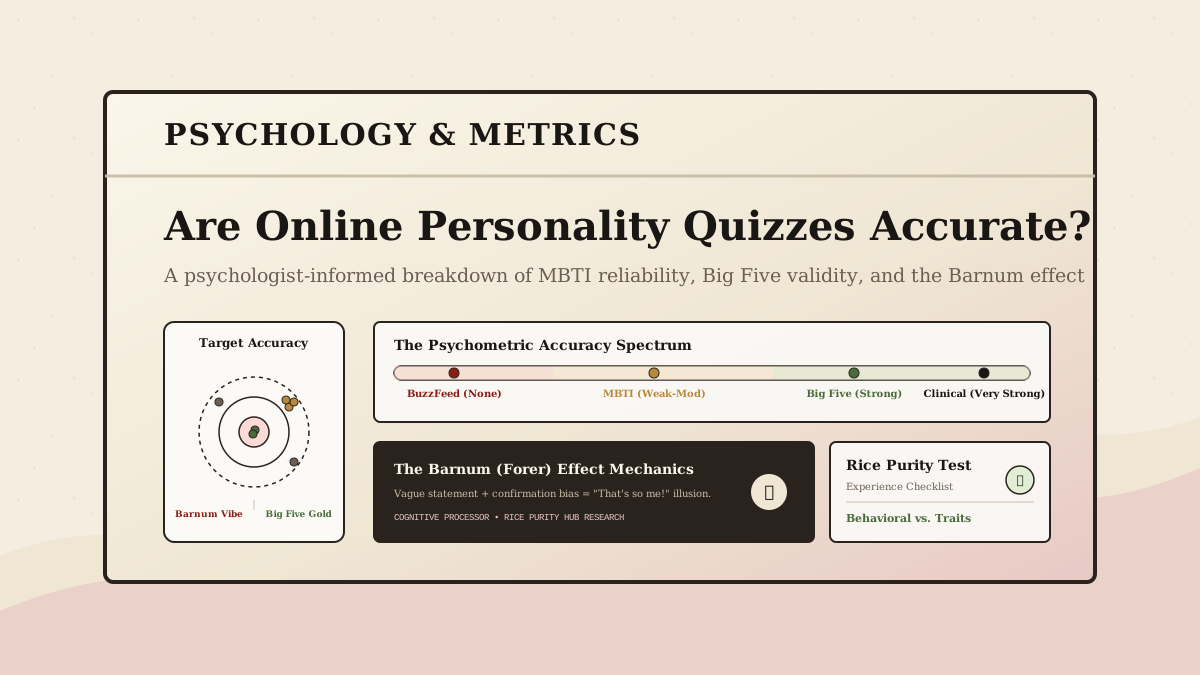
📋 Table of Contents
You take a random quiz at 1 a.m., read your result, and think: okay, that's genuinely me. Then your roommate takes the same quiz, gets the opposite type, and reads it out loud — and somehow that sounds accurate too. So which is it? Are personality quizzes accurate, or are they just very good at flattering whoever's holding the phone?
Here's the honest answer psychologists give: it depends entirely on what you mean by "accurate." Some quizzes measure real, stable traits with decades of research behind them. Others are engineered to feel true while telling you almost nothing. And weirdly, the quizzes that feel the most spot-on are often the least scientifically valid. Let's break down why — and how to tell the difference in about thirty seconds.
Quick Snapshot
- What it is: A look at whether online personality quizzes actually measure your personality — or just seem to.
- The short answer: Some do (Big Five), some sort of do (MBTI), and most viral quizzes don't at all.
- Two things "accurate" means: Reliability (do you get the same result twice?) and validity (does it measure what it claims?).
- The catch: The "that's so me" feeling is often the Barnum effect — not proof of accuracy.
- Who this is for: Anyone who's ever screenshotted a quiz result and questioned it five minutes later.
- Fun fact: In 1948, psychologist Bertram Forer gave students identical fake "personalized" profiles. They rated them 4.26 out of 5 for accuracy.
⚡ Fast Facts: Personality Quiz Accuracy Dashboard
Strong scientific validity. The industry standard used by research psychologists worldwide.
Weak-to-moderate validity. Great for fun self-discovery but scores tend to fluctuate.
A trick where vague, general statements feel hyper-specific to your personal identity.
A simple experience check, not a true diagnostic personality test. Pure entertainment.
The Question You're Actually Asking
When people ask "are personality quizzes accurate?" they're usually asking two different questions at once — and psychology treats them separately. This is the field of psychometrics, the science of measuring the mind, and it lives or dies on two words.
Reliability means consistency. If you take a quiz today and again in three weeks — same you, same mood-independent traits — do you get the same result? A bathroom scale that shows a different weight every time you step on it is unreliable, no matter how fancy it looks.
Validity means the test measures what it claims to. A scale can be perfectly reliable (shows 150 lbs every time) but invalid (you actually weigh 130). A quiz can consistently sort you into "The Dreamer" and still tell you nothing meaningful about how you'll behave.
A quiz is only genuinely accurate when it's both. Most viral quizzes fail both tests — and that's not an accident.
🎯 Visualizing Reliability vs. Validity
How psychometricians define the two pillars of true quiz accuracy:
Low Reliability, Low Validity
Scattered results. Scale shows a different number every time; tells you nothing useful.
High Reliability, Low Validity
Consistent but wrong. Scale consistently shows 150 lbs, but you actually weigh 130 lbs.
High Reliability, High Validity
Consistent & correct. Hitting the bullseye every single time. The goal of Big Five.
The Accuracy Spectrum: Not All Quizzes Are Equal
Treating "online quizzes" as one category is like treating "vehicles" as one category — a skateboard and a semi-truck are technically both on the list. Here's roughly where popular formats land:
| Quiz Type | Scientific Validity | What It's Actually Good For |
|---|---|---|
| BuzzFeed-style ("Which pasta are you?") | None | Pure entertainment, group-chat fuel |
| MBTI / 16-type tests | Weak–moderate | Self-reflection, shared vocabulary |
| Big Five / OCEAN | Strong | Predicting real-life outcomes |
| Clinical assessments (APA-standard) | Very strong | Diagnosis, done by professionals only |
The pattern most articles skip: the further down this list you go, the less fun the quiz is — and the more accurate it gets. Rigor and entertainment tend to pull in opposite directions.
📏 The Quiz Accuracy Spectrum Slider
Visualizing the trade-off between how entertaining a quiz is versus its scientific rigor:
As scientific validity increases (left to right), the entertainment value decreases, while predictive utility grows.
Why the Least Accurate Quizzes Feel the Most Accurate
This is the part almost nobody explains, and it's the whole game. In 1948, psychologist Bertram Forer handed his students what he called a personalized personality test. Every single student got the exact same description — vague lines pulled from an astrology column, like "you have a great need for other people to like you" and "at times you have serious doubts about your decisions." Students rated it 4.26 out of 5 for personal accuracy.
That's the Barnum effect (or Forer effect): we read specific, personal meaning into statements vague enough to fit almost anyone. It works best when the statements are positive, when they use hedges like "at times," and when they come from a source that feels authoritative.
Viral quizzes are basically Barnum-effect machines. When a result says you're "an old soul who feels deeply but guards your heart," your brain doesn't fact-check it — it goes searching your memory for moments that fit, and quietly ignores the ones that don't. The "accuracy" you feel is your own mind doing the work. Which means the feeling of accuracy is genuinely worthless as evidence.
🔄 How the Barnum Effect Tricks Your Brain
The cognitive loop that turns a generic statement into a "profoundly accurate" profile:
Vague Input
"You have serious doubts about decisions at times."
Self-Projection
Your brain immediately searches for personal memories that fit the statement.
Confirmation Bias
You focus on the matches, and discard times you were highly decisive.
Validation Vibe
"Oh my god, this is SO me! This quiz is amazingly accurate!"
MBTI vs Big Five: The Real-World Comparison
The two heavyweights show exactly how the reliability–validity split plays out.
The MBTI sorts you into one of 16 types (INTJ, ENFP, and so on). It's intuitive, memorable, and hugely popular. But its reliability is shaky: independent research suggests that somewhere between 39% and 76% of people get a different type when they retake it just five weeks later. That's a serious problem, because the entire value of "knowing your type" depends on that type being stable. Its predictive validity for things like job performance is also weak. (MBTI's publisher disputes the harshest numbers, noting individual preference scales are more stable than the four-letter combo — a fair caveat, but the type-switching remains well documented.)
The Big Five — Openness, Conscientiousness, Extraversion, Agreeableness, Neuroticism — is the model most personality psychologists treat as the gold standard. It scores you on continuous spectrums instead of forcing you into a box, it's been replicated across 50+ cultures, and its traits predict real outcomes (job performance, health behaviors, relationship satisfaction) roughly twice as accurately as MBTI-style tests. When Scientific American researchers stripped one trait, Neuroticism, out of a Big Five test, its predictive power dropped by about 22% — a concrete sign each dimension is doing real work.
The shared weakness of both? They're self-report. They can only reflect what you tell them. Answer based on who you wish you were, or on a bad day, and the result bends with you.
⚔️ Head-to-Head: MBTI vs. Big Five
| Feature | Myers-Briggs (MBTI) | Big Five (OCEAN) |
|---|---|---|
| Scoring Model | Rigid categories (16 types, binaries) | Continuous spectrums (percentiles) |
| Test-Retest Reliability | Weak (39% to 76% shift in 5 weeks) | Strong (highly stable over decades) |
| Predictive Power | Low (weak correlation with performance) | High (predicts health, career success) |
| Scientific Consensus | Largely rejected by academic psychologists | The gold standard in academic research |
So Where Does the Rice Purity Test Fit In?
Here's a distinction that trips people up: the Rice Purity Test isn't a personality test at all. It doesn't measure traits, types, or temperament. It's a self-reported behavioral inventory — a checklist of experiences you have or haven't had. So the "is it accurate?" question changes shape entirely.
A behavioral checklist is perfectly "accurate" about the one thing it asks: which items you've personally checked off. What it can't do is measure your character, morality, or worth — and it was never designed to. A lower score doesn't mean "less pure" in any meaningful sense; it means a different set of life experiences. Treating it as a verdict on who you are is the same mistake as treating a BuzzFeed result as destiny.
Curious where you actually land? You can take the Rice Purity Test here — just read your number as a snapshot of experiences, not a scorecard on your soul. If you want context for the digits, our score meaning guide and average scores by age break down what's typical and why comparing yourself to others rarely tells the story you think it does.
🌾 Checklist vs. Construct Measures
Why behavioral tallies differ completely from cognitive tests:
Behavior Checklist (Rice Purity)
- Tally of 100 specific actions
- Requires direct memory recall
- Answers are either Yes/No
- Measures experiences, not character
Construct Measure (OCEAN / MBTI)
- Inferred latent psychological traits
- Measures general preferences/habits
- Answers are Likert scales (1-5)
- Aims to capture core personality
How to Actually Get Value From Any Quiz
You don't have to quit quizzes — just change how you read the results:
- Ask "reliable or valid?" first. If a quiz can't survive a retake, hold its verdict loosely.
- Notice the Barnum move. If a result would fit your best friend equally well, it's not really about you.
- Use results as prompts, not labels. "Huh, do I actually avoid conflict?" is more useful than "I'm officially an INFP."
- Save the big decisions — careers, relationships — for validated tools like the Big Five, not a 10-question quiz.
⚖ ... Scientific Strength Scorecard
Frequently Asked Questions
Are personality quizzes accurate?
It depends on the quiz. Scientifically validated tools like the Big Five are reasonably accurate at measuring stable traits. Most viral and BuzzFeed-style quizzes aren't accurate in any measurable sense — they're built for entertainment and rely on vague statements that feel personal but apply to almost everyone.
Are online quizzes reliable?
Reliability means getting the same result on a retake. Big Five tests score highly here; the MBTI is shakier, with research suggesting 39–76% of people receive a different type after just five weeks. Random fun quizzes have essentially no measured reliability at all.
Is the MBTI scientifically valid?
Partly. The MBTI is useful for self-reflection and giving people a shared vocabulary, but psychologists consider its predictive validity weak and its type-switching a real problem. For consequential decisions, most experts point to the Big Five instead.
Why do quiz results feel so accurate?
Mostly the Barnum (Forer) effect: our tendency to accept vague, flattering descriptions as uniquely true. Your mind fills in specific memories that fit and ignores the ones that don't, so the "that's so me" feeling comes from you — not the quiz.
What's the most accurate personality test?
Among widely available options, the Big Five (or OCEAN / Five-Factor Model) has the strongest scientific backing. Clinical instruments used by APA-credentialed professionals are more rigorous still, but those aren't casual online quizzes.
Is the Rice Purity Test a personality test?
No. It's a self-reported experience checklist, not a measure of personality traits. It's "accurate" only about which items you've done — and it says nothing about your character, morality, or worth.
The Bottom Line
So, are personality quizzes accurate? A validated one like the Big Five can genuinely capture something real about you. A midnight "which cereal are you?" quiz captures your mood and not much else — and the ones that feel the most magically accurate are often just the Barnum effect doing a good impression of insight.
The healthiest move is to enjoy quizzes for what they are: a fun mirror, not a final verdict. Let a result spark reflection, spark a conversation, spark a group-chat debate — then let yourself be more complicated than any number or four-letter code. Want a low-stakes place to start? Take the Rice Purity Test, read your score as a snapshot rather than a sentence, and remember that no quiz gets the last word on who you are. You do.
This article is for entertainment and educational purposes and is not psychological diagnosis or advice. For concerns about mental health or self-assessment, consult a licensed professional.
📖 Read Our Latest Published Blogs
Explore more in-depth history, comparison matrices, and psychology explainers from our team:
Quiz Results Meaning
MBTI, love languages, attachment styles — discover what your quiz results really say about you.
TrendsViral Quizzes 2026
From the Rice Purity Test to MBTI and TikTok — discover what quizzes Gen Z can't stop taking.
ComparisonRice vs. Innocence vs. Purity Test
Are they the same quiz? Discover the key differences in formats, origins, and scoring logic.
PsychologyIs the Test Accurate?
Psychologists explain what self-report scores actually measure and why comparisons are misleading.