If you followed AI news today through December 2025, you know it was not a quiet holiday month. The biggest model launch of the season, the biggest entertainment deal of the AI era, and the biggest US regulation fight of the year all landed in the same few weeks, and one packed day, December 11, delivered three of them at once.
This is our month-in-review of AI news in December 2025: the top stories, each with its date and source, the regulation thread that ran under everything, and a plain-English note on why each story mattered. If you want the running daily picture instead, our LLM news coverage tracks the model world as it moves.
The Month at a Glance
Looked at as a whole, AI news today in December 2025 split into two races. The first was the model race: OpenAI and Google answering each other within days. The second was the rules race: Washington moving to rein in state AI laws while Brussels debated slowing down its own.
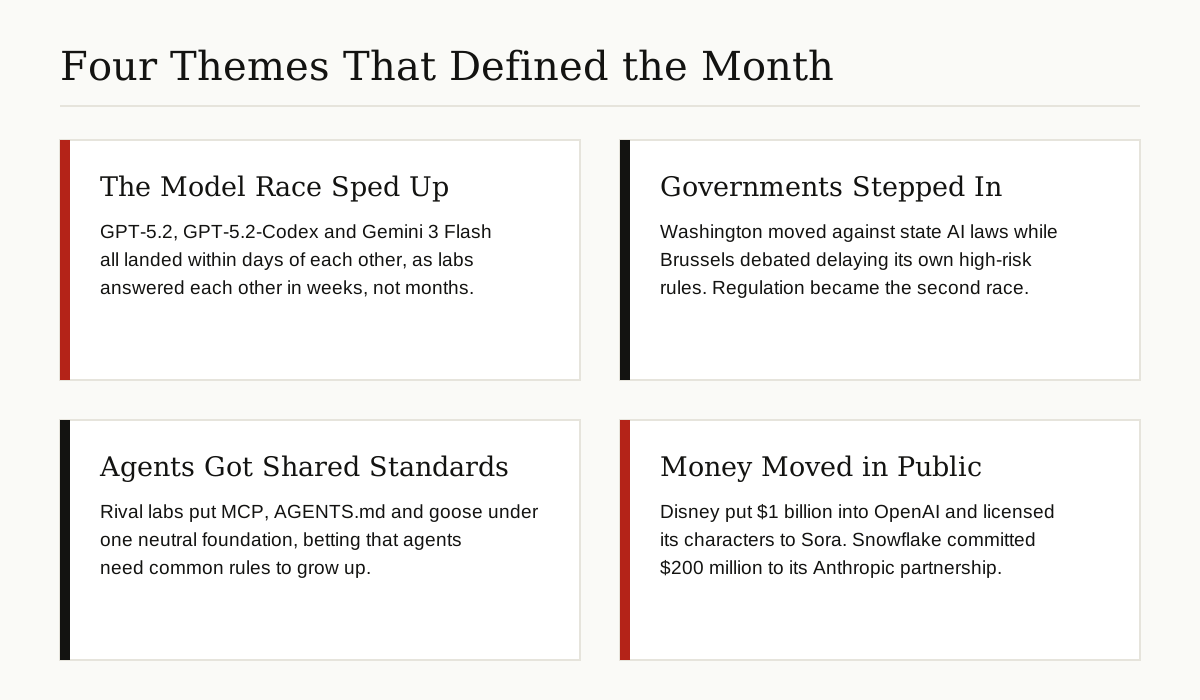
Four themes tied the month together, and they are worth keeping in mind as you read the stories below.
The Top Stories of December 2025
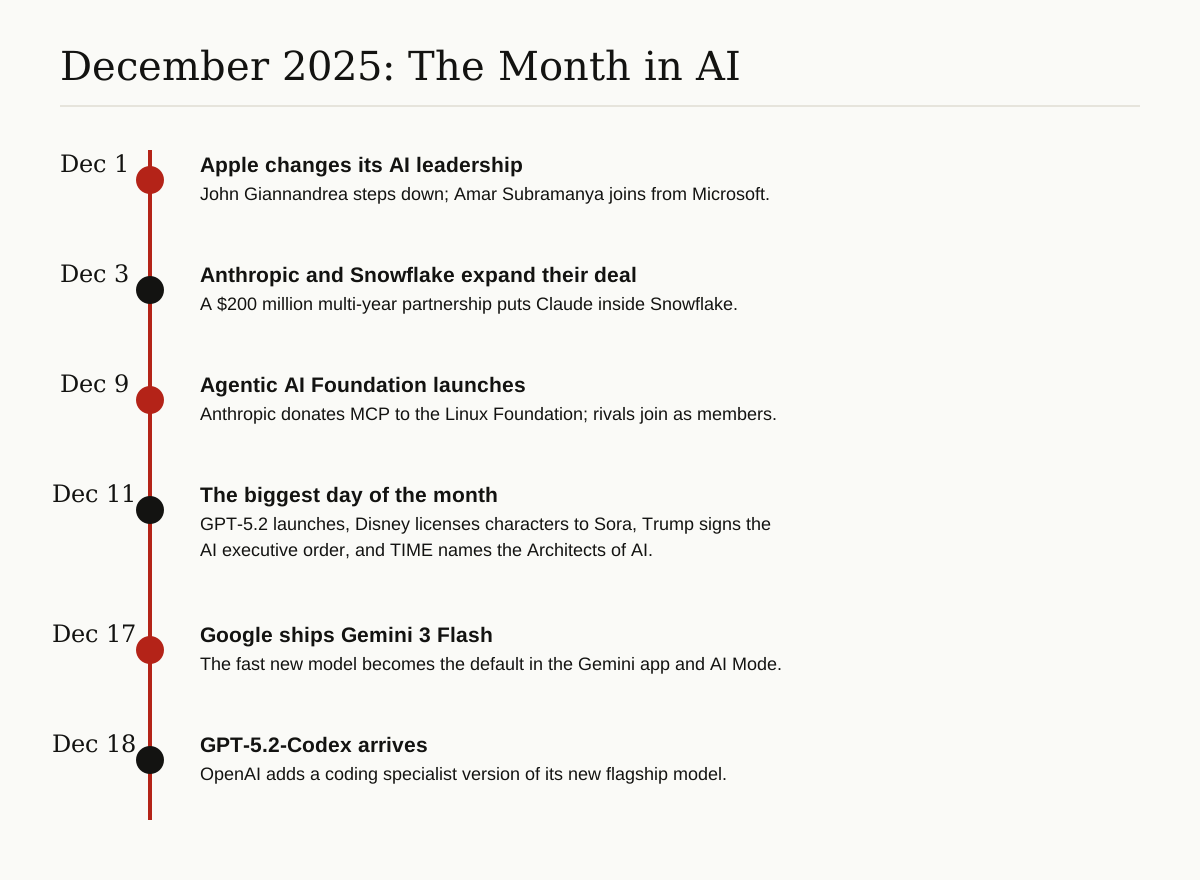
December 11: OpenAI launches GPT-5.2 after a reported “code red”
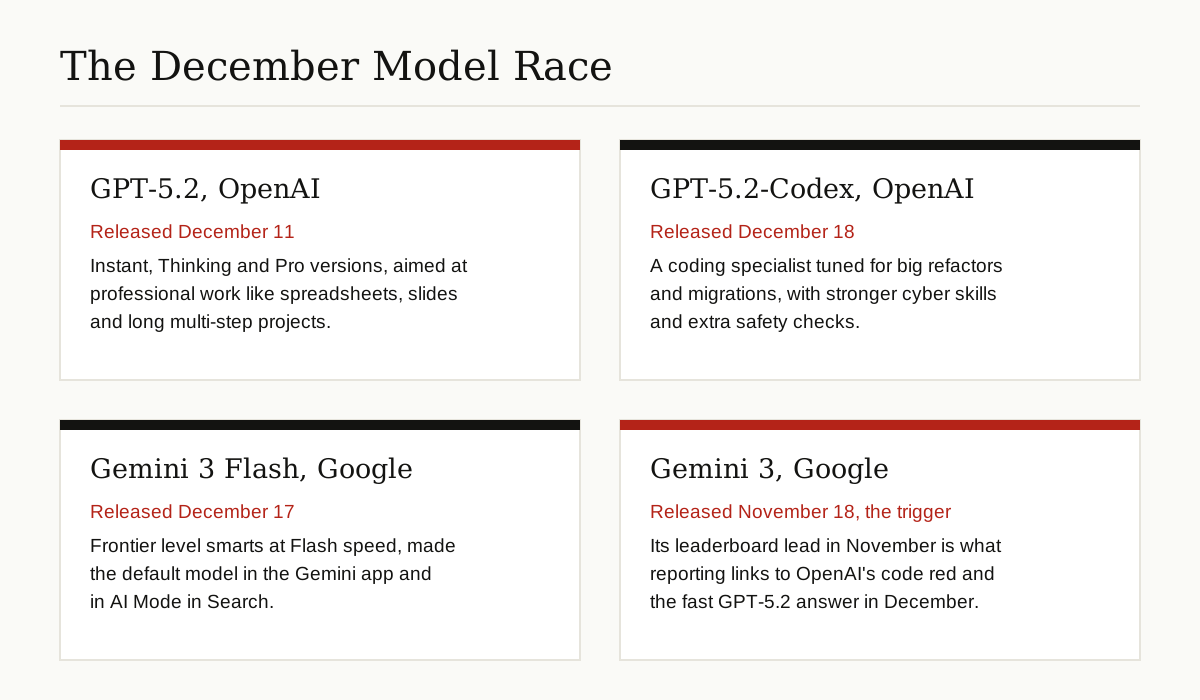
OpenAI released GPT-5.2 on December 11, in three versions called Instant, Thinking and Pro. According to Reuters reporting on the launch, CEO Sam Altman had issued an internal “code red” in early December, pausing side projects and pushing teams to speed up ChatGPT after Google’s Gemini 3 topped several popular leaderboards in November.
OpenAI said GPT-5.2 was its most capable model series yet for professional knowledge work, with gains in general intelligence, coding and long documents, and it pointed to better results on spreadsheets, presentations and complex multi-step projects. Altman also told CNBC that Gemini 3 had “less of an impact on our metrics than we feared,” a sign of how public the rivalry had become.
Why it mattered: GPT-5.2 came only about a month after GPT-5.1. The old rhythm of one big model a year was gone, replaced by launches measured in weeks.
December 11: Trump signs an executive order aimed at state AI laws
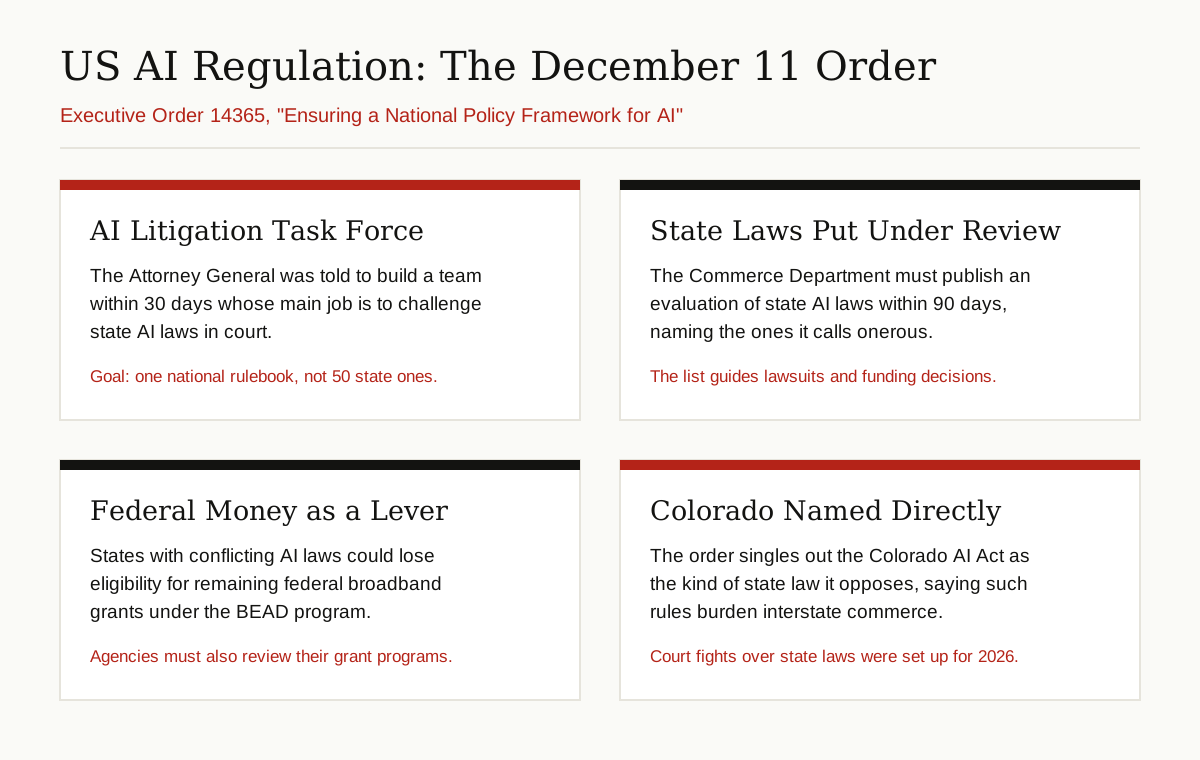
The same day, President Trump signed Executive Order 14365, “Ensuring a National Policy Framework for Artificial Intelligence.” As EDUCAUSE Review summarized the order, it set out to sustain US AI leadership through a “minimally burdensome national policy framework,” and it took direct aim at the growing pile of state AI laws.
The order told the Attorney General to create an AI Litigation Task Force to challenge state laws in court, told the Commerce Department to publish an evaluation of state AI laws within 90 days, and warned that states with onerous laws could lose eligibility for some federal broadband funds. Law firm analyses of the order noted that it names the Colorado AI Act as the kind of law it opposes. We break the US side down further in the regulation section below, and our agentic AI news coverage follows what the order means for agent builders.
December 11: Disney licenses its characters to Sora in a $1 billion OpenAI deal
Also on December 11, Disney and OpenAI announced what Disney called a landmark agreement. Under a three-year licensing deal, Sora can generate short fan-made videos using more than 200 characters from Disney, Marvel, Pixar and Star Wars, and a selection of those videos will stream on Disney+. Disney also agreed to a $1 billion equity investment in OpenAI and became a major OpenAI customer. The full terms are in Disney’s official announcement.
Two limits stood out. The deal covers animated, masked and creature characters, plus costumes, props and settings, and it does not include the likeness or voice of any actor. Reaction in Hollywood was split: the Writers Guild of America said the deal appeared to sanction the use of members’ work and promised to press Disney on the terms.
Why it mattered: a year earlier, studios were mostly suing AI companies. December 2025 showed the other path, a paid license at a billion-dollar scale.
December 11: TIME names the “Architects of AI” its Person of the Year
TIME closed the same remarkable day by naming the “Architects of AI” its 2025 Person of the Year, according to the Associated Press. The covers pictured eight people: Mark Zuckerberg, Lisa Su, Elon Musk, Jensen Huang, Sam Altman, Demis Hassabis, Dario Amodei and Fei-Fei Li.
TIME said 2025 was the year AI’s full potential “roared into view” and that there was no turning back. It was a cultural marker as much as a news story: the magazine chose the builders of the technology, not the technology itself.
December 1: Apple replaces its AI chief
The month opened with Apple. In a December 1 press release, Apple announced that John Giannandrea, its senior vice president for Machine Learning and AI Strategy since 2018, was stepping down, would advise the company, and would retire in spring 2026.

His replacement as vice president of AI is Amar Subramanya, who joined from Microsoft, where he was a corporate vice president of AI, and before that spent 16 years at Google, where he led engineering for the Gemini Assistant. At Apple he leads Apple Foundation Models, ML research and AI Safety and Evaluation, and reports to software chief Craig Federighi.
Why it mattered: Apple had spent 2025 apologizing for a delayed, more personal Siri. Hiring the engineer who helped build Google’s rival assistant was the clearest sign yet that Apple planned to fix its AI story from the top.
December 9: Rival labs hand agent standards to the Linux Foundation
On December 9, the Linux Foundation launched the Agentic AI Foundation, and the founding donations told the story. Anthropic donated the Model Context Protocol, the popular standard for connecting AI agents to tools and data. OpenAI contributed AGENTS.md, its format for guiding coding agents. Block contributed its open source agent, goose.
The platinum members list read like the whole industry at one table: AWS, Anthropic, Block, Bloomberg, Cloudflare, Google, Microsoft and OpenAI. CIO Dive reported that analysts saw the move as a step toward easier enterprise adoption of agents.
Why it mattered: competitors agreed that agent plumbing should be shared and neutral, a rare moment of cooperation, covered in depth in our agentic AI news reporting.
December 3: Anthropic and Snowflake sign a $200 million partnership
On December 3, Anthropic and Snowflake announced a multi-year, $200 million expansion of their partnership, as TechTarget reported. The deal put Claude models in front of Snowflake’s more than 12,600 customers across AWS, Azure and Google Cloud, with a joint push on AI agents that can run multi-step analysis on company data.
Why it mattered: the enterprise race was not only about who had the best model. It was about whose model sat closest to a company’s data, and December kept proving it.
December 17: Google ships Gemini 3 Flash and makes it the default
Google answered OpenAI on December 17 with Gemini 3 Flash, a fast model built on the Gemini 3 family it had launched in November. Google made Flash the default model in the Gemini app and in AI Mode in Search around the world.
Google said Flash kept much of the Pro model’s reasoning strength at Flash speed and cost, and that it used about 30 percent fewer tokens than Gemini 2.5 Pro on typical work. Why it mattered: defaults are distribution. Putting a frontier-class model in front of every Search and Gemini user raised the floor for what free AI feels like.
December 18: GPT-5.2-Codex adds a coding specialist
OpenAI was not done. On December 18 it introduced GPT-5.2-Codex, a version of the new flagship tuned for professional software work. OpenAI said it was better at long coding jobs, large refactors and migrations, with stronger cybersecurity skills and extra safety checks, including an invite-only trusted access pilot for security professionals.
The Regulation Thread: EU, US and the States
Models made the noise in December 2025, but regulation made the history. Anyone tracking ai regulation news today in December 2025 was really tracking two governments moving in opposite directions.
United States: one rulebook, written in Washington
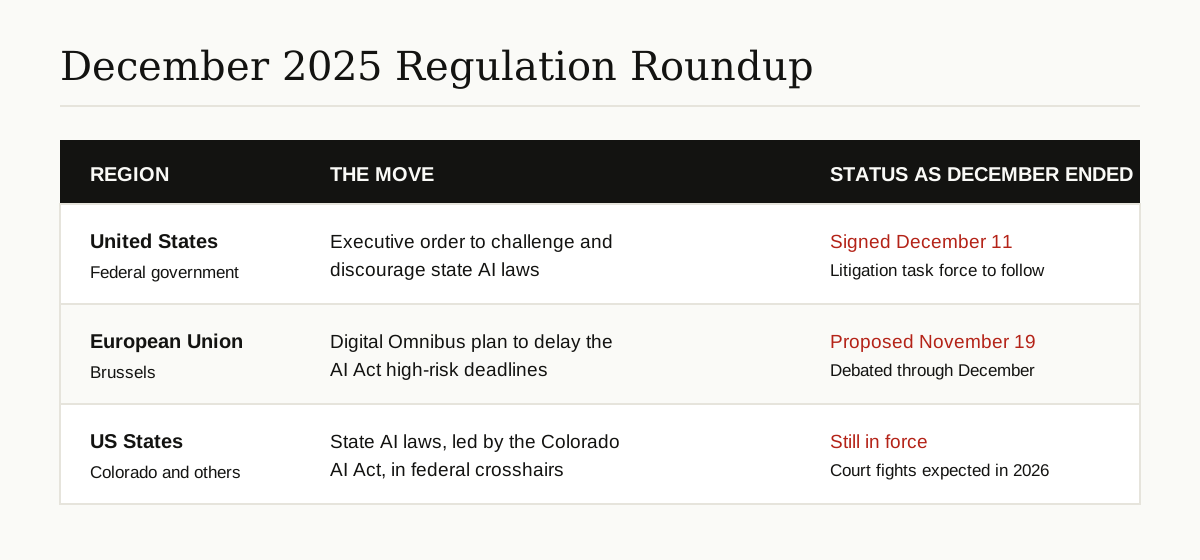
The federal position hardened on December 11 with Executive Order 14365. The argument in the order was simple: a patchwork of state rules burdens interstate commerce and slows American AI. The tools it chose were lawsuits, lists and money. The Justice Department’s new task force would sue over state laws, the Commerce Department would name the laws it considered onerous, and broadband grant eligibility gave Washington a financial lever over state capitals.
Legal analysts were quick to note the limit: an executive order cannot by itself erase state laws the way an act of Congress could. That set up court fights for 2026, which is why us ai regulation news today in December 2025 kept returning to the same question: who gets to write AI rules in America, states or Washington?
European Union: Brussels debates a delay to the AI Act
Across the Atlantic, the eu ai act news today in December 2025 was about slowing down, carefully. On November 19, the European Commission had proposed the Digital Omnibus on AI, a package that would delay the AI Act’s toughest high-risk obligations, which were due to start applying in August 2026. The Commission’s reason was practical: the technical standards, support tools and national authorities needed for compliance were not ready.
Through December, member states and the European Parliament debated the plan, with industry groups pushing for breathing room and rights groups warning against watering the law down. Nothing was final when the month ended. The eventual agreement, reached in 2026, pushed stand-alone high-risk duties to December 2, 2027, and rules for AI built into products to August 2, 2028, while leaving the Act’s bans and transparency duties in place. Our dedicated explainer follows the EU AI Act news timeline in full.
The states do not simply step aside
American states ended December in an odd spot. Their laws, led by the Colorado AI Act, were still in force, still demanding compliance work, and now officially in the federal government’s crosshairs. Companies selling AI in the US had to plan for both worlds at once: state rules on the books today, and a federal campaign against them tomorrow.
Model Releases Recap
The model launches were the loudest part of AI news today in December 2025, and they had a clear shape. OpenAI shipped a flagship and a coding specialist a week apart. Google shipped speed and put it everywhere by default. Underneath both sat the November releases, Gemini 3 and Claude Opus 4.5, that had reset expectations and forced the December pace.
The practical result for users was simple: whichever assistant you opened in late December 2025 was smarter than the one you had used in October, and the gap between the top models was smaller than the marketing suggested.
What December 2025 Set Up for 2026
Four December threads ran straight into the new year. First, the model race: with GPT-5.2, Gemini 3 and Claude Opus 4.5 all fresh, 2026 opened with no clear single winner and launches expected every few months. Second, the US court fight: the AI Litigation Task Force had 30 days to form, and its first targets would show how far the federal government could really go against state laws. Third, the EU delay: the omnibus debate continued into 2026 before the high-risk deadlines formally moved to 2027 and 2028. Fourth, the money: Disney’s billion-dollar bet on licensed AI video and Snowflake’s agent partnership with Anthropic pointed to a 2026 of licensing deals and enterprise contracts rather than pure model hype.
Conclusion
AI news today in December 2025 was dominated by one crowded day and two long races. December 11 alone brought GPT-5.2, the Disney and OpenAI deal, the US executive order on state AI laws and TIME’s Architects of AI. Around it, Apple changed its AI leadership, Google made Gemini 3 Flash the default for millions, rival labs agreed on shared agent standards, and Brussels spent the month arguing over delaying the EU AI Act.
If you remember one line from the month, make it this: in December 2025, AI stopped being only a product story. It became a rules story, a money story and a culture story at the same time, and that is the shape it kept through 2026. For the detailed regulation timeline, continue with our EU AI Act news explainer, or browse the full AI news and regulation category.